
Roadside Drug test (Nigel Gray’s OIA work)
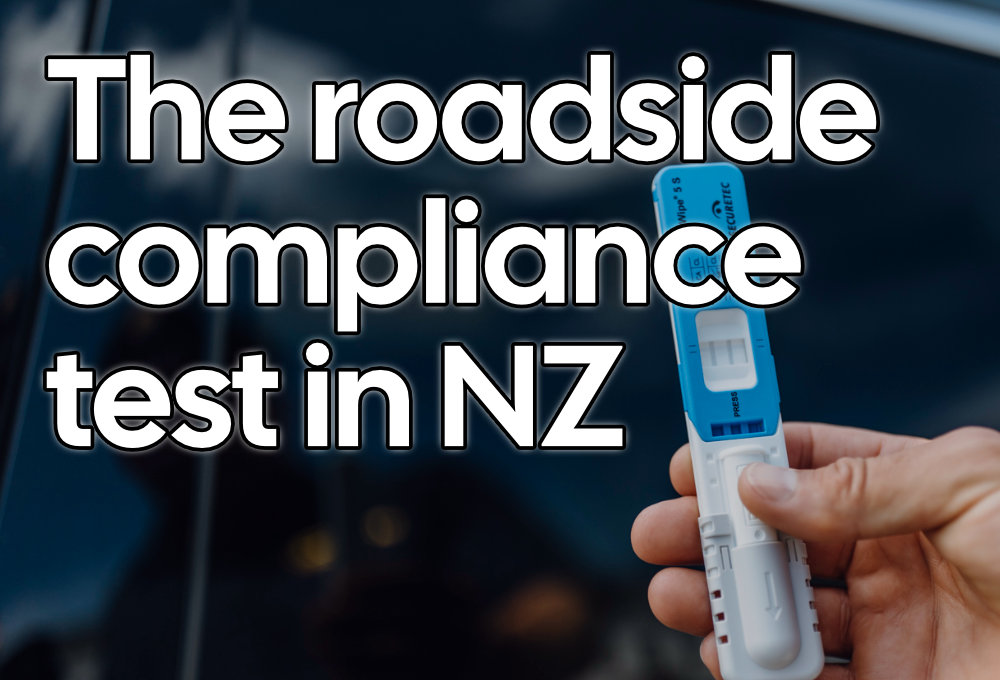
Updated 22 May, 2026 The section below the overview is a reverse chronological posting of researcher Nigel Gray’s work on the Roadside drug test. Nigel has a website https://vivavictorius.yolasite.com where he shows you how to interact with the police during a roadside drug test. Overview Concerns The Roadside drug test pushed by Transport minister Chris Bishop has numerous questions surrounding it’s validity and credibility since it was rolled out in Wellington in late December. It would require drivers to submit to an oral fluid saliva test for detecting the presence of Cannabis, Methamphetamine, Ecstasy and Cocaine. This test does not test for impairment and when detecting for presence it has a 10% false positive rate. There are also a number of other issues, and researcher Nigel Gray has been diligently collecting and raising those issues. Please see below for transcripts of his postings related to this topic. The 3S Drugwipe device by Securetech, is a device that exchanges chemicals with the bodies of drivers that submit to the test and refusal to participate in this exchange results in 75 demerit points, a $400 fine and a 12 hours impounding of the driver’s vehicle. In addition, legislation like the Bill of Rights and Privacy Act appear to be in breach and yet the New Zealand Police and Government fail to acknowledge this. Furthermore, this is a test that is coercive and will leave a number of people feeling frustrated and humiliated with an increasing loss of trust in the Police. Nigel Gray’s roadside drug test research (click to expand) 19 May: Oral Fluid Testing – What police admitted, denied, and document revelations By Nigel Gray 19 May 2026 PLEASE SHARE PLEASE DON’T MISS READING THE UPDATE AT THE BOTTOM….IT IS NOT TO BE MISSED! Over the last two weeks I have been requesting basic, legally‑required information from NZ Police about the chemical composition, safety data, and biological properties of the new roadside drug‑testing devices now being used across the country.Today, Police responded.And the response is — frankly — astonishing.Because while Police refused large parts of the request, claiming documents “do not exist”, they also accidentally released internal training documents that directly contradict their own OIA answers.This update sets out: what I asked for what Police claimed what their own documents show and why this matters for public safety, privacy, and legal compliance 1. What I asked Police for I asked for: Safety Data Sheets (SDS) for the oral‑fluid devices chemical composition of the buffer and preservatives hazard classifications manufacturer documentation any internal risk assessments any DNA‑related documentation any privacy or legal assessments any correspondence with manufacturers retention, disposal, and secondary‑use policies These are standard, basic documents for any biological sampling system. 2. What Police claimed in their OIA response Police claimed: A. THEY HAVE NO SDS OR CHEMICAL DOCUMENTATION BEYOND WHAT IS ON THEIR WEBSITE. (But the website does not contain SDS for Quantisal or the buffer.) B. THEY HAVE NO DOCUMENTATION ABOUT DNA PRESERVATION, DEGRADATION, OR STABILITY. They refused this under s18(e): “document does not exist.” C. THEY HAVE NEVER CONDUCTED ANY INTERNAL DISCUSSIONS, LEGAL ASSESSMENTS, OR PRIVACY ASSESSMENTS REGARDING DNA IN SALIVA SAMPLES. D. THEY HAVE NO DOCUMENTATION GOVERNING SECONDARY USE, RETENTION, OR RESEARCH USE OF SAMPLES. E. THEY WITHHELD ALL MANUFACTURER CORRESPONDENCE UNDER “COMMERCIAL PREJUDICE.” F. THEY DID NOT ANSWER THE REQUIRED S23 QUESTIONS ABOUT WHETHER INFORMATION WAS NEVER HELD, NOT HELD, OR REFUSED. In short: Police claim they hold almost nothing. 3. What Police’s own training documents reveal Police accidentally released: the OFT National District Training PowerPoint, and the OFT Lesson Plan These documents contain dozens of internal procedures, assessments, and instructions that contradict Police’s OIA claims.Here are the most serious contradictions. **Contradiction 1 — Police claim no internal assessments exist. Their training documents contain internal assessments everywhere.**The lesson plan includes: internal procedures internal safety protocols internal device‑handling instructions internal biological‑sample handling instructions internal disposal protocols internal chain‑of‑custody steps internal TENR risk assessments internal scenario‑based assessments Police told me none of this exists.Their own documents prove otherwise. **Contradiction 2 — Police claim no DNA‑related documentation exists. Their training documents show biological‑sample handling protocols.**Examples: “Officers must wear disposable gloves when undertaking testing or collection of saliva.” “Check that sufficient oral fluid has been obtained for an approved analyst to carry out their analysis.” “Follow the instructions provided for the oral fluid collection.”These are biological‑sample handling protocols.You cannot have biological‑sample handling protocols without underlying technical documentation. **Contradiction 3 — Police claim no documentation exists about retention or secondary use. Their training documents describe retention, disposal, and elective samples.**Examples: elective samples sample retention for independent testing sample disposal rules sample sufficiency checks sample transfer to PHF Science sample chain‑of‑custody steps Police refused this under s18(e) — “document does not exist.”Their own documents show it does. **Contradiction 4 — Police claim all SDS and technical documentation are already publicly released. Their training documents reference multiple technical documents not in the proactive release.**Examples: Device instruction guides Temperature‑controlled storage requirements Troubleshooting documentation Manufacturer’s instructions Device handling protocols None of this appears in the proactive release.This means Police do hold technical documentation they refused to release. **Contradiction 5 — Police claim no manufacturer documentation exists. Their training documents explicitly reference manufacturer instructions.**The lesson plan states: “Follow the instructions provided for the oral fluid collection.” “Officers must follow the manufacturer’s instructions.”This is direct evidence that Police hold manufacturer documentation.Yet they refused it under s18(e). **Contradiction 6 — Police claim no privacy or legal assessments exist. Their training documents show structured internal decision‑making frameworks.**Examples: TENR risk assessments CIT transition rules crash‑specific pathways disposal rules chain‑of‑custody protocols These are internal assessments.Police claimed none exist. **Contradiction 7 — Police claim no documentation exists regarding DNA stability or buffer chemistry. But the devices used (Quantisal) are ISO‑validated forensic devices with published technical documentation.**Police claim the manufacturer never provided: DNA stability information buffer composition biological preservation data toxicology validation studies This is implausible.Quantisal documentation is standard in forensic toxicology.If Police genuinely never requested it, that is a serious HSWA breach.If they did request it
Gene Technology Bill harms
Click here to return home Updated 14 December, 2025 Gene Technology Bill harms Below are examples of how the application of the Gene Technology Bill could negatively affect your life. Gene Tech Bill harms (click each item to expand) Proposal to remove food labelling (Gene Technology Bill tie-in with Digital Identity) Digital Labelling proposal Sold as a means to “boost supermarket competition” the government are proposing to replace physical food labels with digital alternatives “Information could be made accessible in-store and online via on-shelf QR codes, in-store digital labels, websites and mobile apps” The implications this has for the customer are numerous: The customer could be required to carry a digital device into the supermarket if they need product ingredient information when making a purchase decision. Privacy issues: Does registering to the supermarket become a requirement to find this information? Is search data being kept or stored in some way? Food labelling requirements could become ambiguous to the point where shop owners inadvertently fail to provide key basic information Learn More Gene Tech Bill would allow biotech injected into farm animals BOVAER cattle ‘feed’ Bovaer, a cattle feed supplement developed by dam-firmenich to reduce methane emissions has made cattle sick and die after government authorities mandated its use on farms. If New Zealand passes through the Gene Technology Bill, ‘Solutions’ like BOVAER will become distinct possibilities within the New Zealand food and agricultural ecosystem. Bovaer, are passed on in milk and meat. In the US, the FDA classified BOVAER as a drug, but stated that it will not enforce it. enabling it to be used as a feed additive. This means less stringent testing and no long-term, on-going testing has been or will be carried out. Modifying the microbiome of cows can have serious consequences. Bovaer disrupts their gut bacteria, causing dysbiosis, which can be harmful to their health.” UPDATE 12 November 2025: In a pivotal shift, Denmark’s Veterinary and Food Administration has issued new guidance: Farmers can immediately suspend Bovaer administration if they “suspect” it poses risks to herd health. NOTE: This is after being mandated to use it. New Zealand, opting into the Gene Technology Bill, would likely face such mandates for livestock, even if they are later found to be harmful. Learn More NZ Govt has already failed an international agreement they have signed Lorem ipsum Lorem ipsum dolor sit amet, consectetur adipisicing elit, sed do eiusmod tempor incididunt ut labore eten dolore magna aliqua. Ut enim ad minim veniam, quis exercitation ullamco laboris nisi ut aliquip ex ea com mmodo consequat. Learn More
HNSO Act vs Gene Tech Bill

Up until 2025, all Gene Technology issues have fallen under the HNSO Act. Therefore in order to see what potential changes lay ahead, it is important to establish the differences between this Act and the Gene Technology Bill. Here’s a clear, side-by-side comparison between the current HSNO Act (Hazardous Substances and New Organisms Act 1996) and the new Gene Technology Bill. This shows exactly how the independence, precaution, and consultation processes change — and what that means for regulatory sovereignty and local safety. 🔹 Overview Purpose HSNO Act 1996 Gene Technology Bill (2024/2025) Main focus To protect people and the environment from the adverse effects of hazardous substances and new organisms (including genetically modified ones). To regulate gene technology and related activities, aiming to “enable innovation” while managing risk. Regulator Environmental Protection Authority (EPA) New Gene Technology Regulator (central authority under MBIE or MoH, depending on implementation). Philosophy Precautionary and independent: NZ must assess all GM or gene tech applications locally before approval. Harmonised and fast-track oriented: NZ must follow decisions of two or more overseas “recognised authorities” for medical activities. 🔹 1. Decision-making independence Element HSNO Act Gene Technology Bill Local scientific assessment Every new organism or genetically modified product must undergo a full NZ-based risk assessmentbefore approval (s. 38, s. 44). If at least two overseas regulators have already authorised it, NZ must automatically approve it (s. 50). Regulator discretion The EPA may refuse approval if data is insufficient or if local conditions pose unique risks. The Gene Tech Regulator cannot refuse, except in cases of “imminent risk” of death, injury, illness, or serious environmental harm. Standard of proof Uses the precautionary principle: lack of full scientific certainty is not a reason to approve. Shifts to a reactive standard: must approve unless clear imminent danger exists. 🔸 Effect: NZ loses its ability to “pause” approval pending local data or uncertainty. The burden of proof shifts from “prove it’s safe” to “prove it’s imminently unsafe.” 🔹 2. Public and iwi consultation Element HSNO Act Gene Technology Bill Public submissions Required for most GM applications (s. 53, s. 54). The EPA must publicly notify applications, accept written submissions, and may hold hearings. The new Bill does not require public notification or consultation for “mandatory medical authorisations.” Decisions can be made administratively. Māori consultation The EPA must consider Treaty of Waitangi principles and consult where relevant (s. 6(d), s. 8). Māori impact assessment is standard practice. The Bill mentions Treaty principles in general guiding provisions, but there is no mandatory iwi consultation for specific authorisations. Transparency Decisions, risk reports, and submissions are published on the EPA website. Authorisations are classed as secondary legislation, so they’re published only after approval — public has no input beforehand. 🔸 Effect: The public, iwi, and scientists in NZ may have no opportunity to question or contribute before foreign-approved gene technologies are authorised domestically. 🔹 3. Risk evaluation scope Element HSNO Act Gene Technology Bill Environmental context Must consider NZ’s “unique flora, fauna, and ecosystems” (s. 4A). Only prevents approval if “serious environmental harm” is imminent — a much higher threshold. Health and social factors Must consider health, social, and ethical implications, including public acceptability (s. 4, s. 5). Focused mainly on scientific and technical compliance; social or ethical review is not required. Adaptive management Allows conditions requiring ongoing monitoring, reporting, and review. The Regulator may impose conditions, but there’s no requirement for ongoing public reporting. 🔸 Effect: Environmental and social risk assessments become narrower and more reactive. 🔹 4. Sovereignty and international alignment Element HSNO Act Gene Technology Bill Reference to overseas decisions Overseas approvals may inform NZ assessments, but EPA remains independent. Overseas approvals dictate NZ authorisation (mandatory). Local override power NZ can delay or deny any GMO or gene tech product based on local conditions. NZ can only deny if there’s an imminent threat of serious harm — otherwise it must align. Policy intent “Protect New Zealand’s people and environment.” “Enable the safe and responsible use of gene technology.” (shift toward enabling). 🔸 Effect: Decision-making authority effectively shifts from Wellington to overseas regulators like the FDA or EMA. 🔹 5. Practical impact examples Scenario Under HSNO Act Under Gene Technology Bill A new gene-edited wheat approved overseas EPA conducts full NZ risk assessment (impact on native grasses, cross-pollination, biosecurity). Regulator must approve if two overseas authorities did, unless imminent harm is proven. A new mRNA vaccine or gene therapy approved overseas Medsafe and EPA assess safety, storage, distribution, and NZ clinical trial data. Regulator must authorise it once two overseas agencies have — no independent safety reassessment. Public opposition or iwi concern Public submissions and hearings possible; iwi consulted. Decision made administratively; public informed after approval. 🔹 6. In plain summary Area HSNO Act (1996–2024) Gene Technology Bill (2024+) Decision basis “Better safe than sorry.” “If they approve, we approve.” Public voice Guaranteed. Optional or absent. Regulator’s discretion Broad — can require new evidence, refuse, or delay. Narrow — must approve unless imminent harm. NZ sovereignty Full control over GM and gene tech approvals. Shared or ceded to overseas regulators. 🧭 Overall meaning The Gene Technology Bill fundamentally changes New Zealand’s biotechnology governance from an independent, precaution-based system to a harmonised, compliance-based system.That means NZ: Gains speed and access to overseas innovations, But loses local authority to demand extra evidence, environmental testing, or public input before approval. Updated discussion on the Gene Technology Bill October 9, 2025
Gene Technology Bill – Claim 1

Updated 27 October, 2025 CLAIM 1: “If two overseas regulators approve a GMO medicinal product, NZ must approve it, even if it is controversial or banned somewhere else” Answer: Yes – If at least two trusted overseas health authorities (for example, the FDA in the U.S. and the EMA in Europe) have approved a medical activity that uses gene technology or similar, then New Zealand’s Regulator must also approve it automatically — called a “mandatory medical authorisation.” In other words: If other major countries have already authorised a gene-related medical procedure or treatment for people, New Zealand is required to follow suit — unless one of the listed exceptions applies. Where is this dealt with in the Legislation? Part 2, subpart 5, clause 50 Exceptions: The automatic approval requirement does not apply if the overseas authorisation is for: (a) Activities involving animals — Treating an animal using gene tech (therapeutic/veterinary use) Using gene tech to enable an animal medical device Conducting clinical trials (on humans or animals) (b) Or if the overseas authorisation was made under emergency powers (for example, fast-tracked approval during a pandemic or crisis). So: This rule only applies to established medical uses on humans that have gone through normal (not emergency) approval overseas — and not to animal use or trials. The Regulator still has the power to say no if granting the authorisation would cause an “imminent risk” of: Death, serious illness, or serious injury to people, or Serious damage to the environment. So the Regulator must approve unless it’s dangerously unsafe or environmentally destructive. An important distinction: What “Mandatory Medical Authorisation” actually means Despite the word “mandatory”, this clause does not mean that people are forced to take any treatment or product. The word “mandatory” here refers to the Regulator’s obligation, not the public’s. So: “Mandatory medical authorisation” means that the Regulator must approve certain gene-based medical products or procedures if they’ve already been approved by at least two trusted overseas authorities — unless doing so would clearly endanger people or the environment. It’s about fast-tracking regulatory approval, not forcing uptake. Does it mean New Zealanders could be required to take something? No — not automatically. This section only gives regulatory approval (the legal green light to use or offer the product).It does not create any power to mandate medical treatments or compel individuals to receive them. If a future government ever wanted to make a particular medical product compulsory (e.g., as part of a public-health mandate), that would have to be done under separate legislation or emergency powers — not under this clause. So: “Mandatory medical authorisation” ≠ “mandatory medical treatment.” In short Concept Who it applies to What it does Mandatory medical authorisation The Regulator Forces the Regulator to approve a medical product already cleared by two or more overseas regulators Medical mandate The public Would force or require people to receive or use the product (not covered by this section) What powers then, does the Gene Technology Bill provide, and what other legislation do Government have that enables actual medical mandates in New Zealand? Below is a structured explanation showing:1️⃣ What powers the Gene Technology Bill itself provides (and what it doesn’t),2️⃣ Which other Acts actually allow for mandatory medical interventions, and3️⃣ How those powers could or could not interact. 🔹 1. What the Gene Technology Bill covers — and what it does not cover The Gene Technology Bill is primarily about: How gene technologies are regulated, tested, approved, and monitored in NZ. Giving a Regulator authority to approve, licence, or restrict products and activities involving gene technology. It is not a health mandate law.The Bill: Allows the Regulator to approve new medical products (including those based on gene tech). Does not give anyone (the Ministry of Health, DHBs, or the Regulator) the power to force or compel any individual to take or use those products. Explicitly separates authorisation to supply or use from approval for other purposes (see section 16 of the Bill). So, “mandatory medical authorisation” means the Regulator must issue an approval — it doesn’t mean the public mustcomply with a treatment. 🔹 2. What laws can enable actual medical mandates in New Zealand If the Government ever wanted to require medical interventions (for example, vaccinations or testing), it could only do so under other, separate Acts that already exist. Here are the relevant ones: ⚖️ (a) Health Act 1956 This is the main public-health powers law. It allows: Section 70(1)(f) – a Medical Officer of Health (under ministerial direction) can require people to be isolated, quarantined, or disinfected if they pose a public-health risk. Section 70(1)(ea) – they can require persons, places, or things to be disinfected, tested, or treated, if necessary to prevent the spread of a notifiable disease. ✅ However:These powers can only be triggered during a declared public-health emergency, and only with specific written orders.They are temporary, reviewable, and subject to judicial oversight. So while these powers could enforce treatment in certain emergency contexts, they are not automatically invoked by the Gene Technology Bill. ⚖️ (b) COVID-19 Public Health Response Act 2020 (still on the books but largely inactive) This Act was used during the pandemic to issue vaccine and testing mandates.Those powers could technically be revived or reused for another declared epidemic. However, they: Require a ministerial order, Must be tied to a declared epidemic or emergency, and Expire unless renewed by Parliament. So again, not automatic — only if government and Parliament actively invoke them. ⚖️ (c) Civil Defence Emergency Management Act 2002 Used in wider emergencies, but even here, medical treatment cannot be compelled unless authorised through the Health Act mechanisms above. 🔹 3. How these powers could (or could not) interact Here’s how the pieces fit together: Stage What law applies What it allows Who it affects 1. Regulatory approval Gene Technology Bill (e.g., s50 “mandatory medical authorisation”) Allows the use or supply of a gene-based medical product in NZ The Regulator / companies 2. Public-health programme Health
The Gene Technology Bill

Updated 10 October, 2025 The section below is an abbreviated summary from an article by Guy Hatchard that provides an overview of the Gene Technology Bill. Overview Concerns Calls for caution The Gene Technology Bill if adopted will deregulate biotechnology in New Zealand. It would remove labeling requirements for genetically modified (GM) products and treat GM techniques as safe by default. This represents a major policy shift away from precaution and transparency. The bill aligns NZ with global biotech and corporate interests, rather than protecting local independence, environment, and food integrity. The biotech sector has a history of failed promises, most recently the mRNA COVID-19 vaccines that was promoted as safe and effective but shown to have caused harm. Despite the industry’s connection to health dangers, biotech firms are now seeking new markets in agriculture and food production. New Zealand’s Gene technology bill will help to accomodate this if enacted. Companies are lobbying for weaker safety rules to cut costs and accelerate experimentation. A major concern is that the government are trusting corporate science without adequate independent oversight. The position we have is New Zealand need to reject the bill and maintain strong biosafety and labelling laws. This means a ban on gene editing and gain-of-function research, due to the ethical and ecological risks that come with such allowances. A return to natural food systems and independent scientific evaluation of biotechnology claims. The Gene Technology issue as a turning point for New Zealand national sovereignty, and the stakes are high. Once Pandora’s box has been opened, reversal of the effects of certain biotechnologies cannot be reversed. IMPORTANT INFORMATION (What govt. and mainstream media aren’t saying) The Gene technology bill isn’t about passing one law, it is about a whole system of changes quietly working together in a regulatory type of lockstep. The Gene tech bill is proposing to completely deregulate GMO into Farming systems, medical applications, and more importantly – your food. It will give corporations more control over food supply. They will have no liability. No traceability. And they will pass on the cost of any GMO contamination to YOU, the tax payer. And at exactly the same time, the NZ food safety authority is laying the groundwork for labelling requirements for GMO in your food products. Specifically, proposal P1055 is updating how gene technology, and new breeding techniques, are defined under New Zealand food law. Essentially this is redrawing the boundaries as to what counts as genetically engineered food, so they don’t need to relabel it anymore, even though it is genetically modified. So just to be clear here, the reason they’re saying they don’t need to label it anymore is because they’re saying they’re using modern gene editing methods, so they’re not considering it as genetically modified So they can bypass labelling or premarket safety checks. Not only is this dishonest, but it makes it harder for consumers to know what is in their food and it takes away your right to choose. Biosecurity minister Andrew Hoggard is the one in charge of how transparent your GMO labels are. Meanwhile the Ministry for primary industries are calling for the raising of acceptable limits of glyphosate by 100 times. This lines up with making GMO herbicide resistant crops easier to get into the soil of new zealand. On top of that, the RMA reforms are removing precautionary principles against genetically engineered organisms and stripping away those safeguards that protect ratepayers. That means communities have less say, less protection and more risk offloaded onto the public. All of these changes work together. They reshape how our food is grown, who owns it, who controls it, and how honest your food labelling is. Updated discussion on the Gene Technology Bill October 9, 2025
New Zealand IHR Amendments update
New Zealand’s IHR Amendment update Highlights: New Zealand Government rejected Article 59 of the IHR Amendments NZ Government DID NOT reject the Amendments New Zealand released their negotiation mandates in February, 2024. The mandates are concerning because they use the words ‘should’ instead of ‘must’ when it comes to things like upholding human rights A critical eye must be kept on the New Zealand government as they move into a decision making period over the IHR.